Showing posts with label Time Management. Show all posts

Wednesday, 2 October 2013

SEARCH ME: A Final Reflection on EYES

"The you of today is a survivor, a very close survivor, of the you of yesterday. It is a survivor, though a slightly more distant survivor, of the you of last week, and a much more distant survivor of the you of last year. In a single body is not one person one self or person, but a succession of selves, a river of selves, each one a survivor of the one that went before. To the extent we can talk of the self, we are talking of something that has the character of a river, a process, not a thing."

- The River of Selves from The Philosopher at the End of the Universe.


"Memories - you're talking about memories."

- Rick Deckard, Blade Runner


Anxiety and Boredom: June 2012 – September 2012

This project started life in the spring of 2012 as a short film and was something that I did a great of deal of preparation for during my summer break. The short film idea that I toyed with throughout the summer was called A&B (which stands for ‘Anxiety and Boredom’) and it was hugely influenced by the experimental art house film Radio On


However, while A&B was a very strong visual idea that would have intensely explored the themes of anxiety and boredom, it lacked a clear narrative to express those themes. I certainly was all for creating a very strong visual presentation in acknowledgement of all the films that had nurtured me and which I had come to fully appreciate through my academic ventures in Film Studies, but as my degree was also concerned with creative writing, I felt that it was only fair that I honour both sides of my degree by delivering a final product that was visually very strong and complimented by an equally strong narrative. As such, I abandoned A&B and started again.

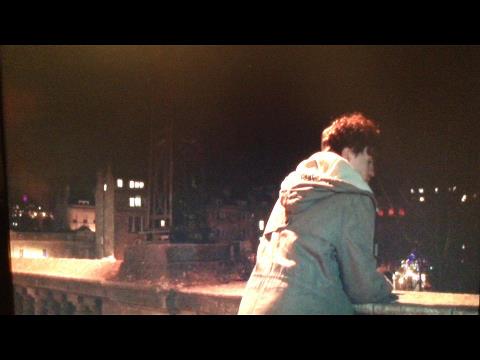
Look familiar?
Coinciding with the initiation of my final year in September 2012 I hit on a new idea – an idea that concerned itself with a character called Boris who liked to collect photographs of peoples’ eyes and this became the EYES short film idea. This Idea I certainly appreciated much more so than the A&B idea as it provided a better starting point from which to develop a narrative. I even toyed with the potential of doing it as a mockumentary! Very early on I could see that the basic premise of the idea was building on my Busybody script; a script that I had submitted for my short filmmaking module in the previous year and which also concerned itself with the process of looking as it had been a script about voyeurism. The starting idea for Busybody was of a landlord who installs hidden cameras into all of his properties; from that basic premise I was able to develop a narrative that dealt with two characters who liked to engage in voyeurism. Clearly I had a subconscious agenda to look at the gaze, as this same theme came up in my other two final year projects Ways of Being and Fencing

However, as I now had a clear starting idea that offered both visual and narrative potential, I was confident that I could produce a strong short film out of it – a calling card for myself.

And then I listened to my doubts.


Storytelling and Experimentation: October 2012 – November 2012

The redeeming feature of the Creative Enterprise Project module is that it provides each student with a blank canvass on which they can paint whatever project they like; it is also a module designed to get the students out into the industry they want to work in, so that when they graduate they can get employment in that industry. To this end, I wondered if there was something better I could do than a short film. The reason why I wanted to do a short film is because I felt that the short films I had helped produce in Planning and Making a Film, my filmmaking module from the previous year, were only marginally representative of my potential and, now that I had access to the necessary resources, I saw the Creative Enterprise Project module as a chance to rectify previous errors and produce a short film that absolutely expressed my potential, opposed to being a botch-up. However, at the end of it all, I was really just making a short film for myself, because it had always been something I had wanted to do to a high level. The industry initiative was secondary. Therefore, I felt that I owed it to myself to do something that would be highly beneficial to my career aspirations and would directly assist me in securing a job once I had graduated. 


It was always about looking for a new approach.

To this end, I sought advice from the person who had tutored me in Planning and Making a Film: Mike Johnston. Mike was the person who suggested that I could do a web series project that would entail the construction of a series bible document and a pilot episode. He suggested this as a better option because it would more fully exploited the full range of skills that I had nurtured over the course of my degree. Furthermore, the ability to tell an ongoing story, opposed to the self-contained narrative of a short film is much more appealing to the industry. Today in the industry, there is much more emphasis on television and movie franchises and stories that are told in multiple parts.

The marvel cinematic universe is a key example of this shift towards mulit-part stories.

Mike made a compelling case for undertaking a web series project and he even suggested that I take it down the transmedia route, but I was hesitant to do this as it would have created more work. However, I was pretty sold on the web series idea because it would still allow me to conduct filmmaking in the form of the Pilot; as well as allowing me to express my creative writing and contemporary industry awareness. It was also a challenge as I knew virtually nothing about the relatively new web series medium, but challenges generate a great deal of creativity. 


I seem to be obsessed with looking.


The next step was taking the story idea for the EYES short film and moulding it into something that could be an ongoing story. Fortunately, as the EYES short film idea had only recently been formed it was still a proto-idea and, therefore, was very ripe to be shaped into any form or medium. During the process of creating the web series story idea it became obvious that what I needed was an overarching concept that would carry the web series identity and allow each episode to develop its own stories based around that common concept. Another problem arose that I was running out of time and by this point I was already going into November and I knew that if I was going to pull this project off I would need to get the pre-production phase largely done before Christmas! Therefore, I took to recycling previous Ideas that I had used in past projects. P.S. was the first short film script that I had written for submission in the Planning and Making a Film module, but had decided against submitting it as it was very complicated – it was complicated because it dealt with telepathy.

Imagine a world where all human consciousness was connected together like wifi.

I had written P.S. about telepathy because telepathy is something that has always interested me and I have always wondered what the world would be like if it actually existed. Therefore, as it was an abandoned script I felt that it made sense to give that concept a second chance and I realised that the complicated nature of something like telepathy meant that there were innumerable stories that could be told about it – therefore, it would serve as an exceedingly good overarching concept for an ongoing story. Also, the idea of putting thinking and looking together immediately seemed like a very natural idea. Telepathy is also a very unconventional subject that does not get covered much and I saw it as offering the potential for experimentation in the way that a story could be told around it. I was sold.


Tuesday, 17 September 2013

EYES Planning Portfolio

As part of the Creative Enterprise Project module, I was required to produce a document that would detail your vision, research and planning for your project. This is my planning portfolio document which is a synthesis of a the Planning Portfolio document I produced before Christmas and the updated one I completed just before the final submission in May. In addition to the Appendix Materials, this document is an expression of the administrative elements of the project.


The previous three drafts of the planning portfolio can be viewed in this Google Drive folder.

Sunday, 19 May 2013

EYES Feedback: Project Members

I encouraged all of the members of EYES to submit some form of feedback in regards to their experiences of working on the project, what they have gained from it and their views of my project management skills. I tend to be quite blunt and that is a skill I have nurtured even more so this year; as such, I encouraged everyone to be as honest and critical as they possibly could. 

Presented below is all the feedback I received from the members of the project (for viewer/target audience feedback, see Rough Cut 2 Feedback). I absolutely agree with all of their feedback points and I'm glad to see they have gained a lot from the project.


Mykel Elledge ('Boris')


Matt Coot (co-producer)


Daniel Tapper (Sound Designer)


  • Your experiences of working on the project.

My experience of working on the project has been essentially good. Its nice to work on a project with someone who has a clear vision of what they want to achieve. Most of the time Peter was able to communicate clearly what he wanted but at points what he asked for seemed a little convoluted and occasionally contradictory to something he had previously said. However I felt that both of us were pretty much on the same page meaning we were able to work effectively together and come up with a clear plan of action.


  • What you've gained from the project.

Previously my sound work has been for quite visually abstract works such as animations, adverts and a short horror audio visual film. Working on EYES was the first time I had worked on a more structured narrative project and proved a good bridge for me between abstract and more structured dramatized work as EYES has elements of both. 


  • You're views on me and my project management skills, etc

I think Peter has done a good job managing the project. From my experience managing even a small team can prove difficult. The role I am performing is fairly straightforward and doesn’t require a lot of management but from working in the field with Peter I have seen that he is able to inspire others to commit themselves to hard work in pursuit of his vision. Peter is also very personable, helpful and unintimidating making which contribute to his leadership skills as people are not afraid to put their views across.


Claire Rowbotham ('Lianne') 


When approached to be a part of this project as an actress, I was thrilled as Pete seemed really keen to have me and this enthusiasm was what made me sure that I wanted to commit to the film. EYES for me was an extra-curricular project during my own very busy third year, and if it wasn’t for his passion and drive for the film I probably would have chosen to not do the film and concentrate on my own studies. So a note for Pete would be to keep this attitude up because it really is the difference between people wanting to be a part of a project in their own time and not.

Saying that, the script was also a huge reason I wanted to be a part of the film. The script intrigued me hugely and I wanted to find out more; both about the storyline and the characters. This is great as obviously if you have the audience hooked and wanting to know more then you are onto a winner. The script went through quite a few drafts throughout rehearsals, but this for me was a good thing rather than a bad thing; Pete was brilliant at watching us in rehearsals and then adapting the script so that both his actors felt happier and so that his script communicated more clearly what he wanted it to. It didn’t mess the process up for myself as an actor because changes made were always beneficial to my character and he didn’t have us learn lines for the shoot until he was sure that he was happy with the script. The only thing I would say he could change about the rehearsal process would be to have a slightly clearer structure for rehearsals. I believe this was Pete’s first time directing and I feel that he could achieve more for himself and actors, as a director, if he knew of more exercises that would could participate in to help make our performances stronger. Pete however, had a naturally lovely way of telling us what he liked us doing in rehearsals and this was encouraging.

As Pete was so full of ideas, which ultimately is a good thing as it led to bigger and better things, it could be a little bit confusing knowing what he wanted. But I believe this was a part of the development process rather than a hindrance. It was also very interesting to see how his ideas developed and blossomed. I must point out that in the end, once he realised what it was he needed portraying, he was very clear in what he needed for us. To make the process quicker in future I would just say maybe he should have the idea slightly more developed in his head before getting other people involved with it.

Throughout the whole experience, Pete kept everyone very well informed via the facebook group page and he was always very communicative. He was always easy to get hold of which was brilliant for when I needed questions and queries answered. Through the facebook page I also got a great insight into the huge amount of research he was doing; I could tell he was looking at lots of different elements of the film and because I saw him doing all of this, I felt more like a part of the production team rather than just an actress. I am not sure if this was his intention? But I feel like this was a good thing. Maybe on larger projects he would need to define the boundaries between production team and cast more, but I felt that for this intimate production it worked and I learnt a lot more than I would have done if I was just sent a call sheet and the lines I needed to learn.  The only downside to the facebook page is that as there were so many posts, sometimes I would lose track of the posts that I actually NEEDED to know about. So maybe a more direct approach to certain individuals about what was need to make things clearer if it only concerned them? 

Pre-production seemed to be organised well as when we turned up for the actual shoot, there were no problems with locations or anything and we could just get on and film. Everyone knew what they were doing and I didn’t feel as if he ever forgot to do anything important that slowed down the shoot. I would say next time however, that he get a slightly larger production crew so that he could concentrate on solely directing.  During actual filming,-on set directions were clear and he knew what he wanted which was great.
During the whole process, Pete was very accommodating to my own needs with regards to what suited me and my studies and this was a necessary trait which he needed to have for me to be a happy member of his team. So big well done for that. 

Pete’s general approach to everything was very passionate and he was clearly determined to create the best film he could which was contagious, but I would say he needed to be careful of his manner at times. Sometimes I was unsure if he was angry/stressed or just concentrated and determined. Overall I think he could have made it slightly more obvious if he was feeling positive about what was happening, but he never spoke to be rudely and so I enjoyed being around him. I was just unclear with how he felt at times, if he was joking or not, which made me unsure of how to react. Pete was great to work with though and it would be a pleasure to work on another film with him again some time soon.

From the entire project I have gained a lot for myself; I have had a lovely on set experience, I have learnt a huge deal about how different people work, I learnt a lot about the script development process and I have obtained fantastic random information from the research facebook page. Being a part of EYES was a great experience and Pete deserves to do well in the future.


Letitia Ringshaw (Production Assistant and 'Ella')


The following is all the feedback I got from Tish. 


Although, to be fair, she has been quite busy.


Myself

This is the feedback I supplied Matt with for Remember This, I have included it here as I make many comparisons between Matt and myself and our two projects. Ultimately, these videos can be seen as feedback and reflections on myself and EYES, as much as they are on Matt and Remember This (ignore the amount of 'ands' in this sentence).


EYES Facebook Group

For the project I knew that I needed a single location where I could keep it relatively organised and keep the other members in the loop as to what was happening. I have found in the past that when all the members are not kept in the loop it can lead to problems and, certainly, I think this is one of the main problems Matt's organisation of Remember This suffered from!

However, a Facebook group seemed like a safe bet, as I had been part of a Facebook group for my second year short film submission and I had found it to be a highly useful communication tool. Another great thing about Facebook is that everybody is always on it, which means that I would be able to reach people fairly quickly and get replies just as swiftly. 

The EYES Facebook Group.

EYES Facebook Group
As I knew whatever I ended up doing as part of the Creative Enterprise Project module would require a great deal of my time and energy, I created the group on the 10/10/2013 and the group been continuously active since then! 

Initially the only people in the group were Matt Coot (co-producer), Letitia Ringshaw (Production Assistant, 'Ella') and myself. It was only after Christmas that I added Mykell Elledge ('Boris'), Claire Rowbotham ('Lianne'), Daniel Tapper (Sound Designer) and Kate Pullinger (my project tutor). 

The group members.

Before Christmas the posts and discussions in the group largely consisted of ideas I had for my project and online resources I had come across. If you want to see how the EYES Web Series evolved from a very vague notion into the web series concept proposal it is now, then look in the Facebook Group (and on this blog). I would say that I have done more communicating and organising via this group than I have done in the real world!

The group has a search function - the magnifying glass next to notifcations and the settings button!

I believe my use of the EYES Facebook Group is also the reason why my multitasking skills have improved, as I would often be communicating via the Facebook Group while
simultaneously doing other tasks. The group has also enabled the whole project to be much more collaborative for all involved and if you want solid evidence of where I have been enterprising in my project then the Facebook Group is a solid bet!

I consider the EYES Facebook Group to hold just as much weight as this blog and, as such, the Facebook Group forms appendix materials. 

Wednesday, 1 May 2013

Pete's Reflection on Short Form Documentary Making 2012-13

This is my final reflective post for the wiki that was used to chronicle the making of Fencing documentary. I have re-posted it on this blog as the post's contents have some bearing on the EYES project, as the documentary was produced alongside my Creative Enterprise Project.


D for Dud


My relationship with the documentary medium has always been a problematic one; I have always been somewhat mistrustful of documentaries and their validity as a representation of actuality. Philosopher and social critic Slavoj Žižek has commented: “In order to understand today’s world, we need cinema. Literally, it is only in cinema that we get that crucial dimension which we are not able to confront in our real reality. If you are looking for what is in reality, more real than reality itself, look into the cinematic fiction” (2006). This is a logic I have always felt to be true and my argument against the documentary has always been a simple one: why try to be a representation of actuality when a fictional presentation can reveal far deeper truths about reality? This was something I wanted to explore as part of the module and, certainly, this is what I was trying to achieve in my documentary premise The Importance of Lying.


Pumping Iron is a ground-breaking documentary due to its debunking of the ignorant perceptions surrounding bodybuilding – I think it is fair to say Pumping Iron was in my subconscious while making the Fencing documentary! While I did enjoy Pumping Iron as a factual piece of entertainment, I found the sequel/making-of documentary Raw Iron to be much more interesting and revealing! 


As Pumping Iron is quite openly a docu-drama there are elements of it that are fictional or highly manipulated from their original occurrences in reality. Raw Iron discusses these elements of Pumping Iron and explores the reasoning behind their inclusion. The filmmakers argue that they manipulated/fabricated certain elements because it made for a stronger narrative in the documentary. Therefore, by making the primary figures into archetypal characters: the underdog, the bully, the hero, etc, it made for a much clearer and stronger narrative (see the video above: 09:41-10:37). The filmmakers even discuss one scene they staged long after they had finished filming the initial footage! Overall, while I can appreciate Pumping Iron’s strong narrative, the effect of the factual elements saturated with fictional embellishments makes for a largely shallow and untrustworthy experience. Certainly, this is something that all documentaries are guilty of, even the fully ‘factual’ ones: “An edited documentary film is already manipulated; for many of us, staged dramatization, however beautifully shot, leads to an additional loss of credibility” (Kalow, 2011:30).

Initially, my view was: if you’re going to make a fictional presentation, then the documentary medium is redundant! In fact, you shouldn’t even bother trying to create a factual account of actuality because that is an impossible task for any reproductive medium. Rather, it is better to focus on creating a fictional account which, as Žižek says, can present ways of exploring that crucial dimension of reality, the essence of reality, more real than reality itself, that we can feel but never directly witness, except in cinematic fiction. Ultimately, this academic year has been instrumental in showing me that different forms of visual storytelling can embody and explore different ways of seeing, thinking and being. Certainly, once you begin to dissect documentaries on a theoretical and practical basis their complexities and potentials become apparent, as has been the case for me while making Fencing.


The Duality of Fencing


The concept for a documentary about fencing was Tom’s, my role in further developing the idea was in providing an external point of view to Tom’s interior point of view on fencing. To this end and in keeping with my creative identity, I encouraged the challenging of the exterior ignorant perception of fencing as only being a sport for the elite. Therefore, you could argue that we reached a state of equilibrium in our collaborative process, because our viewpoints on fencing balanced each other out: Tom was highly informative and passionate; I was highly analytical and detached.

In addition to our opposing POVs, our artistic styles differed as well. As I have already commented elsewhere on the wiki, particularly in Colour Correction, Tom was more formalistically inclined; whereas I was more inclined towards to realism. This isn’t to say that I didn’t have formalistic tendencies and Tom didn’t have realists ones; rather Tom’s majority was towards formalism and mine was towards realism.


Tom setting up one of his formalistic shots (top) with the finished product (bottom).

As I have already commented in my reflections on the shoot pages (see Further Reflections), my realist inclinations can be seen in my ‘fly-in-flight’ filming style (‘in-flight’ as I was moving around). As I was the outsider, I filmed with an observational eye allowing everything to run its course in actuality. Certainly, this filming approach was drawn from my dissatisfaction with the ‘fictionalisation’ of documentaries, my POV of the outsider and from my wish to create a visually strong presentation:

“Shoot “observationally,” that is, record people and events in their natural setting, as if you were a fly on the wall. Allow events to unfold, observing and capturing reality. Your subjects don’t need to narrate for the camera because you can always add explanatory narration later, during the editing process. Good observational technique reveals character and story, bringing deep visual interest to your documentary” (Kalow, 2011:13).

However, while Tom’s style was equally visually strong, his was more in-amongst the action and knowledgeable about the various nuances of fencing. Generally, his footage is comprised of medium to close-up shots that know what to look out for in fencing; whereas mine are medium to long shots unbiasedly recording anything that is seemingly revealing. Regardless of our filming approaches, both Tom and myself were very much aware of the influence capturing and framing an image in a particular way can have on its eventual presentation:

“The camera does not see as the eye sees, even though it records visual information. Your eyes can naturally and effortlessly dart from place to place, follow the action, and focus in on the telling detail… Any movements, such as zooms or pans, should serve to advance or deepen your story. Always remember to settle on a shot for ten to fifteen seconds. If you shoot a lot of activity or a performance, position yourself close to the action” (Kalow, 2011:8).

Overall, I believe that our opposing styles worked to further balance our working relationship in regards to the qualities that each of us could bring to the table and, ultimately, has made for a rich and varied documentary presentation on the perceived stereotype of fencing and its true diversity in actuality. Below I have created a detailed reflective commentary on the final cut together with my original edit of the 2nd half and a few other points besides. 


As I said in the reflective commentary, our differing POVs are very much embedded within the narrative itself. I think this point is crucial in understanding what I have gained from my studies of filmmaking this academic year. The construction of a film from its various elements and artistic inputs informs the type of impression the film will provide and the attributes of its consciousness:

“Since its invention film has been compared to the mind, whether through analogy with human perception, dreams or the subconscious. The shock of seeing a world ‘freed’ by man’s imagination caused many early writers to see a profound link between the mind of the filmgoer and the film itself, leading them to understand film as a mirror of mindful intent. In a sense film offers us our first experience of an other experience (the experience of the film camera as it were). Film seems to be a double phenomenology, a double intention: our perception of the film, and the film’s perception of its world. Thus our understanding of our world can be informed and changed by this other way of experiencing a world, this other view of a similar world” (Frampton, 2007:15).

In short, psychology is essential to successful filmmaking! I believe this is why our documentary works so well because the logic of the psychology was there right from the beginning. Aside from Tom and myself working very well together, we picked a subject and premise that we were both ideally suited to tell:

Tom is a fencer. He is highly knowledgeable and passionate about fencing. He had access to the Bath Sword Club.

I am not a fencer and I am not very knowledgeable about fencing. In fact, I bought into the ignorant stereotype. However, I am very analytical and tend to ask a lot of questions.

These two basic viewpoints/starting points were enough to present a documentary about an honest portrayal of fencing in which its dominant stereotype is challenged. As such, we went into filming having crafted a strong narrative structure that exemplified the aim above. Throughout filming, in addition to filming together, we actively exploited our differing filming styles by filming on our own. As the filming took place over the space of a month we kept questioning each other and discussing our eventual aims – we actively kept our POVs in debate with each other.

Ultimately, like the preproduction period, the filming period proved to be another research period in which we could more directly contextualise our subject matter. Furthermore, with our postproduction period, we were able to bring out our individual POVs by initially editing both halves of the documentary in isolation and then unifying those two approaches when we brought the two halves together to create what would become the final cut (see the Editing Log). Therefore, throughout this whole process, we have encouraged each other to keep working on our own psychological terms; while also combining those two psychological approaches to inform what has always been the essential aim of the documentary – debunking the myth of the fencing elite and exposing the true diversity.

Duality is an integral theme that permeates throughout the documentary: it finds expression through our two POVs, it is present in the visual design of the documentary and it exemplifies the basic premise.


The side by side shots in the documentary are examples of dualism in the film form.

As such, this integral dualistic theme was something I felt was essential to convey in the trailer. As Tom had taken on the duty of assembling the final cut of the documentary, I took on the duty of creating the trailer. Below I have created a detailed reflective commentary on my thinking behind the construction of the trailer. Included are the two rough cuts together with the final cut and a few other points besides.


My cerebral editing style, which I mention in the reflective commentaries, has much more so become apparent to me as a result of making the documentary and having to actively exploit my POV. Indeed, as I said in the documentary commentary and again in the trailer commentary, the arrangement and pace of audio-visual information has a huge impact on the construction of a film’s consciousness and how the psychology of that consciousness is experienced by the spectator:

“When it works, film editing – which could just as easily be called “film construction” – identifies and exploits underlying patterns of sound and image that are not obvious on the surface. Putting a film together is, in an ideal sense, the orchestrating of all those patterns, just like different musical themes are orchestrated in a symphony. It is all pretty mysterious. It’s right at the heart of the whole exercise.” (Murch in Ondaatje, 2002:10).

Certainly, I think Murch’s statement has a lot to say about Žižek’s exclamation that cinematic fiction presents an understanding of reality, more real than reality itself. Successful filmmakers identity patterns and underlying currents of subtext in the collective consciousness that they are then able to exemplify and exploit in their work. This process is something akin to epiphany and, certainly, something I believe Tom and myself have done throughout the construction of the documentary. While I would say that my editing style is cerebral in a suggestive quality, I would describe Tom’s as being more on the nose and directly cognitive; however, these two approaches again work to bring out the dualistic quality of our POVs and the essential narrative aim of the documentary.


Tom's use of keyframing is one embodiment of a dualistic cognitive process happening within the documentary.

By embellishing the narrative with our psychologies and allowing our POVs to debate with each other, we have been able to give the documentary a dualistic consciousness of its own. A dualistic consciousness that complements the viewer’s consciousness as they watch and consider the subject of fencing as the documentary itself does. The visual style of the documentary, particularly in its dualism, gives the impression that an active cognitive debate is happening within the documentary itself, as indeed it is: “Documentary is really a screen version of human consciousness doing its living work” (Rabiger, 2004)!

I believe that the whole process of creating Fencing has greatly improved my psychological thinking in regards to filmmaking and the way in which I, as a filmmaker, want to manipulate the spectator. Certainly, if you view my reflection on editing the Character Study and/or my contributions in the Editing Log you will see that I often discuss the psychology behind what I am doing and why I am arranging the audio-visual elements in a particular way – the ways of seeing, thinking and being I am trying to encourage in the spectator.


The Documentary Paradox

We now live in an age where the concept of documenting is more alive than ever. While the majority of people are oblivious to it, everyone is documenting their lives and chronicling their life story as a result of their participation on social media platforms. This assembling of a life story in the cyberspace archive will go on to inform how we are defined, long after we are gone. John Berger elaborates on this, albeit long before social media platforms were even a concept:

“Adults and children sometimes have boards in their bedrooms or living-rooms on which they pin pieces of paper: letters, snapshots, reproductions of paintings, newspaper cuttings, original drawings, postcards… they have been chosen in a highly personal way to match and express the experiences of the room’s inhabitant. Logically, these boards should replace museums” (1972:23).

These 'online boards' we create about ourselves are supplying the narratives of our lives; each new status update, tweet, photo post, comment made, meme spread or video shared act as individual beats in those narratives. However, above and beyond creating a legacy, these 'online narrative boards' are playing an active role in our everyday lives. Our narrative boards have their own consciousness and existence parallel to our cognitive and corporeal ones – they are our digital alter egos.


Impressions of ourselves are being stored online and expanding our narrative selves - our digital alter-egos.

Therefore, it is not just a narrative created solely by ourselves, but an interactive one which grows by contributions and manipulations by countless friends and followers. Our boards are creating fictionalised versions of ourselves based on our experiences and interactions in actuality. In addition to this, the rise of content sharing platforms and consumer filmmaking products has encouraged the user-generated production of documentaries. Documenting is now a fundamental part of our everyday lives and, as a result, the documentary medium is experiencing a renaissance. Therefore, the concepts of documenting and the documentary are more important than ever! However, if we consider the documentary as the purveyor of truth, in light of it also being a: "creative treatment of actuality" (Grierson in Rabiger, 2004), where does this leave the documentary medium as a reliable representation of reality?


In 'F for Fake' Orson Welles dissects the reproductive medium and compares filmmakers to charlatans.

The fact of the matter is – documentaries lie! It is impossible for a documentary or any reproduction of reality to present a completely unfiltered and unbiased representation of actuality: “Tell it by the fireside, or In a marketplace, or in a movie. Almost any story is almost certainly some kind of lie.” (Welles, 1973). However, as this academic year has shown me, this is not a disadvantage, but the redeeming feature of the documentary medium!

Documentaries present more than truth - through the indirect – a lie – they present a deeper and a more fundamental truth about human consciousness – we need lies to give truths their values. Lies are an essential component of humanity. As much as there is a paradox at the heart of every human being, there is a paradox at the heart of reality and in our knowledge of that reality. It is only through documentaries and other cinematic fiction and their cognitive abilities to closely mimic our own cognitive functions that we are able to glimpse and even to understand this underlying paradox, this underlying truth that can only ever be accessed via a lie: “Life is cognitive, not narrative. We need narration to understand it, but we live it cognitively” (Reygadas, 2013). Cinematic fiction takes the cognition of reality and contextualises it in a narrative – the narrative translates the hidden truth of actuality for us: “it is only in cinema that we get that crucial dimension which we are not able to confront in our real reality. If you are looking for what is in reality, more real than reality itself, look into the cinematic fiction” (Žižek, 2006). To this end, the documentary medium is by no means redundant; it is just another mode of cinematic fiction through which we can paradoxically experience falsehoods that allow us to understand the truth:


“As a charlatan [filmmaker], of course, it was my job to make it real, not that reality has anything to do with it… what we professional liars wish to serve is truth; I’m afraid the pompous word for that is art. Picasso himself said it, ‘art,’ he said, ‘is a lie – a lie that makes us realise the truth.’” (Welles, 1973).

Unlike the state of the real world and our online narratives/alter-egos which are becoming just as confusing and paradoxical as our cognitive and corporeal happenstances in the physical realm, documentary, as a mode of cinematic fiction, offers us a simplified and contextualised narrative/point of view of actuality: “In order to understand today’s world, we need cinema” (Žižek, 2006), we need lies to help us realise the truth of our actuality. Therefore, documentaries are essential because they allow us to better understand the world!

From my point of view the incentive for Fencing was in providing a context through which I and like-minded spectators could come to understand the larger diversity of fencing; while disposing of the elite stereotype - the initial and dominant image I believed was the case with fencing. Furthermore, being the co-author of Fencing it is interesting to note that the documentary only holds truth for me. Indeed, I find it hard to see how the Fencing documentary, as a revelation of truth against a lie, can possibly be a lie? However - I, as the co-author - therein lies the answer to my question!


My theoretical and practical understandings of filmmaking have greatly improved as a result of this academic year.

Co-creating Fencing with Tom has been an enjoyable and enriching experience; the past six months have proven to be a smooth process devoid of any significant problems (there were a few minor teething technical problems). Certainly, I think this has a lot to say about our working relationship and our highly articulate individual attributes. Our collaborative process was largely a case of one person finishing the other person’s sentence!

In regards to the technical quality of Fencing, Tom and myself were blessed because we already had a significant amount of videography experience prior to embarking on this project. This prior knowledge definitely had an impact on the artistic and stylistic choices we made and, without question, our technical knowledge has grown and been refined as a result of undertaking the Fencing project.

In addition to my increased technical knowledge, my theoretical understanding of the documentary medium, and filmmaking as a whole, has been greatly nourished as a result of this module’s teaching and the process of creating the Fencing documentary. Regardless of my prior views of the medium, the act of documenting has always been something close to my heart and something I have always enjoyed doing - my administrative role on this wiki should be testament to that! However, now that I have been able to apply myself to videography documentary making on a more advanced level, I have acquired a definite taste for it! As a result of my participation in the Short Form Documentary Making module, a transformation has occurred - my relationship with the documentary medium is no longer problematic, it is paradoxical!


Further Reflections

Research – This includes an overview and some reflective writing on the research I did for the module and the fencing documentary.

My POV on Fencing – This is a reflective account of my POV on the subject of fencing.

Character Study – This includes my two edits for the character study and a reflection on its creation, particularly in the editing stage.

10/01/2013: Shoot 1 – This includes a reflection on my experiences and filming approach in this particular shoot.

17/01/2013: Shoot 2 – This includes a reflection on my experiences and filming approach in this particular shoot.

24/01/2013: Shoot 4 – This includes a reflection on my experiences and filming approach in this particular shoot.

31/01/2013: Shoot 5 – This includes a reflection on my experiences and filming approach in this particular shoot.

07/02/2013: Shoot 6 – This includes a reflection on my experiences and filming approach in this particular shoot.

Editing Log – This is a highly detailed account of the editing process in which I have reflected at great length about the evolution of the documentary and trailer.

Discussions – This includes the various discussions Tom and myself had on and off Facebook over the past six months about the documentary project. Most of the significant discussions related to the editing process have found their way into the Editing Log.

My POV – This includes the initial video presentation demonstrating my point of view for the Class Wiki. Also included is some reflective writing on my POV, many of the points raised have found validation in the Fencing project!

EYES of a Storyteller – This is the blog I have been using to chronicle and reflect on the development of my EYES web series project (my Creative Enterprise Project). In many ways, this project has required an equal amount of practical and theoretical work into the nature of narratives and filmmaking as the Fencing documentary. As much as the research I have done for the Fencing documentary has had an influence on EYES: the research I have done for EYES has had an influence on the Fencing documentary. For me these two projects form two sides of the same coin and, as such, have been very actively rubbing off on each other - POV is an integral componant of EYES! Factual and fictional filmmaking have formed two very active components for me in this academic year - my filmmaking has greatly improved as a result of it.


References
Berger, J. (1972) Ways of Seeing. London: Penguin.

Frampton, D. (2006) Filmosophy. London: Wallflower Press.

F for Fake (1973); directed by Orson Welles. 89 minutes. France, Iran and West Germany: Janus Films, SACI and Speciality Films.

Kalow, N. (2011) Visual Storytelling: The Digital Video Documentary. Center for Documentary Studies at Duke University.

Ondaatje, M. (2002). The Conversations: Walter Murch and the Art of Editing Film. London: Bloomsbury Publishing Plc.

Pumping Iron (1977); directed by George Butler & Robert Fiore. 85 minutes. USA: Rollie Robinson, White Mountain Films and Cinema 5 Distributing.

Rabiger, M. (2004). Directing the Documentary. Waltham: Focal Press.

Raw Iron (2002); directed by Dave McVeigh and Scoot McVeigh. 42 minutes. USA: Incue.

The Film Programme (21/03/2013); hosted by Francine Stock. 28 minutes. UK: BBC Radio 4, British Broadcasting Corporation.

The Pervert’s Guide to Cinema (2006) DVD; directed by Sophie Fiennes, hosted by Slavoj Žižek. 150 minutes. UK, Australia and Netherlands: Amoeba Film, Kasander Film Company, Lone Star Productions, Mischief Films and Microcinema International (2006).

Wednesday, 17 April 2013

A Return to the Weir: EYES Filming Day 4 (Pick-ups)

Mykel, Matt and myself filmed four new shots. 


Pick - up shot 1. A shot with Mykel's back to camera performing all of the scene right up to when he turns around to take the cube.


Pick up shot 2 - A close up of Mykel's face when he is performing this part of the scene.


Pick up shot 3 - we had to redo the shot of Mykel putting the cube down as it does not match up with the way the cube is placed down in the earlier shots. We had to do multiple takes of this to ensure I had shots that matched up with the previous takes of Mykel putting the cube down in the preceding shots.


Pick up shot 4 - As we had to re-do the placing down of the Rubik cube shot (see above) this meant that we also needed to re-do the shot of the Rubik cube on its own. As with pick-up shot 3 we did multiple takes of this shot with the Rubik cube placed in different positions to insure I had something that matched up with the new and old footage captured.

In addition to the shots above, after Mykel had gone home, with Matt's assistance I tried out an further extension of pick-up shot 4. This new idea is cliffhanger-like ending to make up for the absence of the trailer and something that you can see when I complete the rough cut...